Why IDS?
International and Diplomatic Studies
International affairs with economics in the core – taught in English, in Prague.
IDS is an interdisciplinary program in international studies at the Prague University of Economics and Business. We are not a political science degree and not a pure international relations degree, and the curriculum shows why.
The bachelor’s program is built in three equal parts. One third is international relations, diplomacy, international law and research methods. One third is economics, finance and quantitative methods. The final third is yours: electives to deepen either side, and a language every semester: German, French, Spanish, Russian, advanced English or Czech from scratch. Most of our graduates leave with two international languages alongside English.
The master’s program shifts toward international politics, security, law and foreign policy analysis, with international economics as its analytical backbone. Half of it is the shared core. A quarter is electives you choose, many of them economic if that is the direction you want. The remaining quarter is a minor specialization of your own choosing, or a semester at one of our partner universities instead.
At both levels you can spend a semester abroad or take an internship, and at both you can continue with us to the next degree.

Many of our students arrive drawn by diplomacy: protocol, negotiation, the practice of foreign service. Those courses are here and they are among the most popular ones we teach. What graduates tell us afterwards is that the other half mattered more than they expected: the sanctions file, the trade dossier and the development budget all turned out to be economic documents. That is the reason the two sides sit together in one degree.
Ing. is the Czech master’s title in economics and business. It is a full master’s degree and is recognized as such abroad. VŠE holds the ECTS Label and the Diploma Supplement Label, and the university is AACSB-accredited.
What sets IDS apart
APSIA, the Association of Professional Schools of International Affairs, brings together leading schools such as Sciences Po, the London School of Economics and the Graduate Institute Geneva. IDS is one of its affiliates, alongside the Diplomatic Academy of Vienna and the European University Institute, and the only school from Czechia in the network.
Small groups
Seminars have about 25 students in the bachelor’s and 20 in the master’s program. Your lecturers know who you are.
An international classroom
Around four in five of our students come from outside Czechia. You will debate world politics with people who have lived it from different sides.
A semester abroad
Spend a semester at one of more than 250 VŠE partner universities, 67 of them with programs in international relations. It is included in your tuition. Continue from bachelor’s to master’s and PhD in the same community.
Where our graduates go
Since 2012, more than 200 graduates from 50 countries. Here are some of the roles they hold today:
- EU Affairs Counsellor, Ministry of Transport of the Czech Republic
- Director of European and International Science Policy, Ministry of Education of Slovakia
- Policy Officer, EU institutions
- Child Protection Associate, UNICEF
- Security Cooperation Specialist, U.S. European Command
- Compliance & Risk Analysis Specialist (Sanctions), financial sector
- Strategy & Chief of Staff, PwC
- Director of Operations and External Relations, Institute of International Relations Prague
Hear it from them
PodcastAliciaHow international studies led to a career in cybersecurity.
VideoNicolaAn IDS graduate looks back on her studies.
Are you an IDS graduate? Join IDS Alumni and Friends on LinkedIn
What it costs, and what is included
IDS is a fee-paying program. Everyone pays the same tuition, whether Czech, EU or non-EU, with no surcharge for nationality.
Your fee is set by the year you enroll and does not change for the standard length of your degree. At the 2027 rate that is €18,000 for the three-year bachelor’s and €12,000 for the two-year master’s.
Included
- All teaching, examinations and supervision
- A semester at a partner university abroad, at no extra fee
- Library, electronic databases and university IT services
- Sports facilities on campus and at the dormitory
- Enrollment, the state exam and the graduation ceremony
Not included
- Accommodation and health insurance
- The €100 application fee
- Living costs
This is a public university with AACSB accreditation, priced below most English-taught international relations programs in Prague. Scholarships are merit-based only, announced each year by the Dean of the Faculty of International Relations and awarded on academic results after the first year.
A place in the university dormitories costs considerably less than renting in Prague. Living costs in Prague · Tuition fee: full details
Prague, and what it costs to live here
Prague is a safe, walkable capital in the middle of Europe, and one of the cheaper places in the developed world to be a student. It is not the cheapest city in Czechia, but compared with Vienna, Berlin or Amsterdam, the gap is substantial.
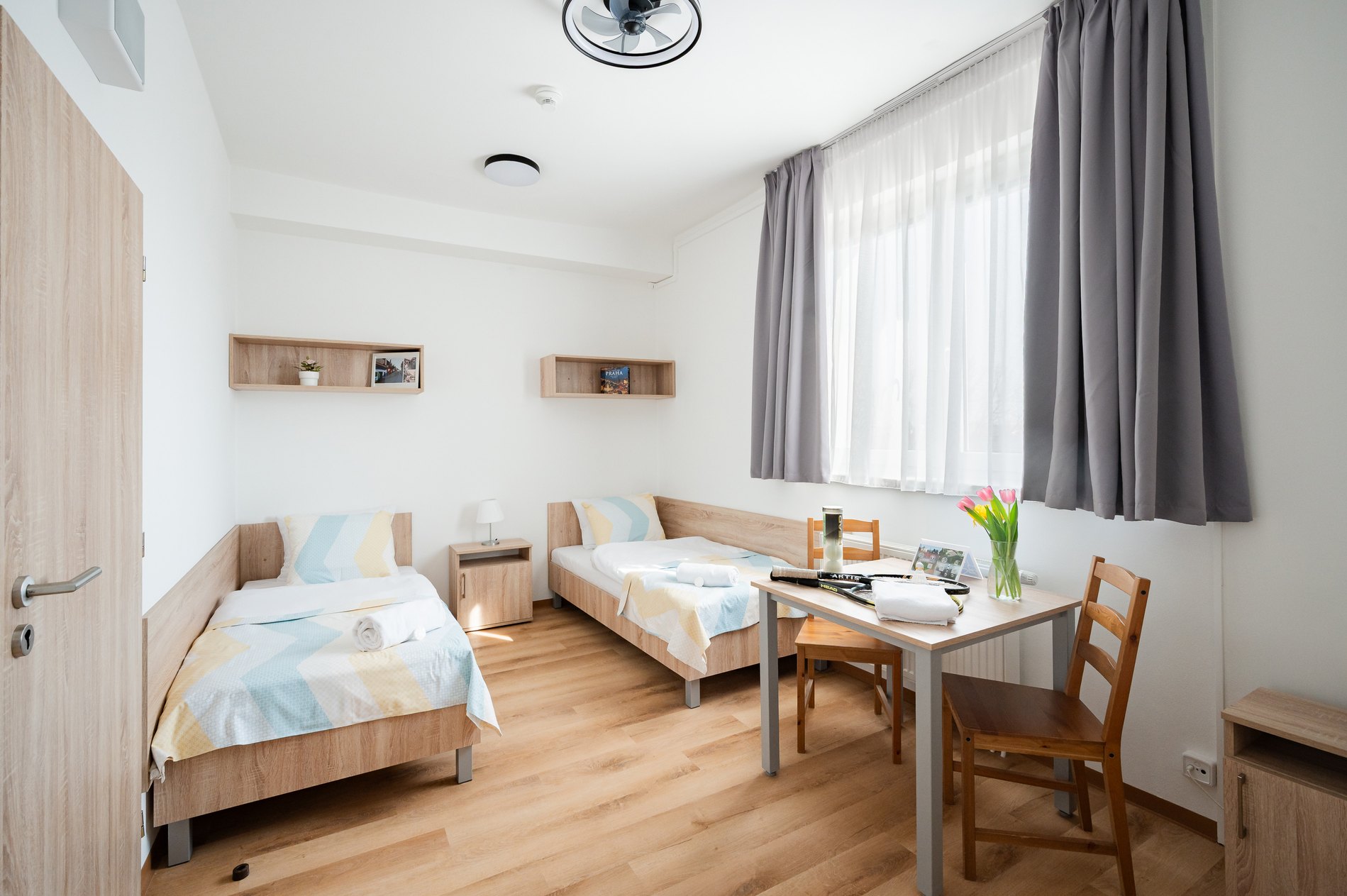
The single largest saving is housing. Renting privately in Prague has become expensive; a place in the university dormitories has not.
If you apply for a place in the university dormitories, you will get one. That also settles the accommodation confirmation you need for your student visa, so you do not have to chase a landlord from another continent.
| Dormitory room | Per month |
|---|---|
| A bed in a twin room | from €180 |
| A single room in a shared unit | around €300 |
| A single room with private bathroom | €360–520 |
Internet included. Rooms are billed per night, so the monthly amount varies slightly. Prices are for enrolled students, academic year 2026/2027.
Including a dormitory room, plan on roughly €550–800 a month, or about €7,000 per academic year, for housing, food, transport and everyday costs. Students get discounted public transport passes, and the university canteens are subsidized.
Accommodation · Living in Prague & Czechia · Visa & health insurance
How to apply
Applications open on 1 November each year.
| Program | Apply by | Studies begin |
|---|---|---|
| Bachelor’s | end of February or end of April | September |
| Master’s | end of February or end of April | September |
| Master’s | end of November | February |
Exact dates: Bachelor’s admissions · Master’s admissions
If you need a Czech visa, apply in Round I, by the end of February.
Visa and residence permit applications take 60 days, and up to 120 in complicated cases, and the process only starts once you have been admitted. The February deadline leaves comfortable time before September. The April deadline can work, but it is tight. The November round for a February start is best suited to applicants who do not need a visa.
Once you are admitted, we issue your confirmation of study and, if you have applied for a dormitory place, your proof of accommodation. We can also nominate you for Student Mode, a fast track to an embassy interview. Visa notice for non-EU applicants
Questions? Write to ids@vse.cz and we will arrange a consultation, in person or online.
Open House Day: online on 8 December, on campus on 18 December